It is the first question in almost every e-commerce conversation, and the honest answer is slightly uncomfortable: it depends. That is not a dodge. A shop with twenty products, card payments and domestic shipping has almost nothing in common with one that syncs stock with a warehouse, sells across borders and handles thousands of references.
What we can do is show you what drives the number, the ranges the market works with, and — most importantly — the costs that show up afterwards and rarely make it into the first meeting.
The ranges the market works with
Published prices cover a wide span: from a modest build for a simple shop to five figures for custom development. The gap looks confusing until you realise you are not comparing like with like.
Broadly, there are three scenarios:
- Entry-level shop. Lightly adapted template, small catalogue, standard payment gateway. The fast route to test whether you can sell at all.
- Professional shop for a small business. Own design, real catalogue, sensible categories, some automation. Where most businesses that already sell — and want to sell better — belong.
- Custom project. Integrations with your ERP or warehouse, complex pricing logic, several languages and markets, or features that simply do not exist off the shelf.
The jump between tiers is not vanity. It is not that the shop looks nicer; it is that it does more work for you.
How artificial intelligence has changed all of this
AI now shows up in almost every stage of building an online store: drafting product copy, retouching photography, speeding up parts of development and handling chat support. That has compressed timelines that used to run months into, in many cases, weeks. But it changes how a store gets built, not necessarily what your business actually needs.
Have budgets stayed the same?
Not exactly. What AI genuinely speeds up is production: writing copy, generating and retouching images, first drafts of code, template configuration. That cuts hours out of the most mechanical part of a project. But the price of a store was never just «hours spent typing code» — it was business judgement, catalogue architecture, integrations with your management system and ongoing maintenance, and that is where AI helps without replacing the judgement of someone who understands your business. That is why entry-level budgets have come down somewhat, especially for simple shops, while projects with complex integrations sit in similar ranges to before.
Template, custom, or AI-assisted custom: which one to choose
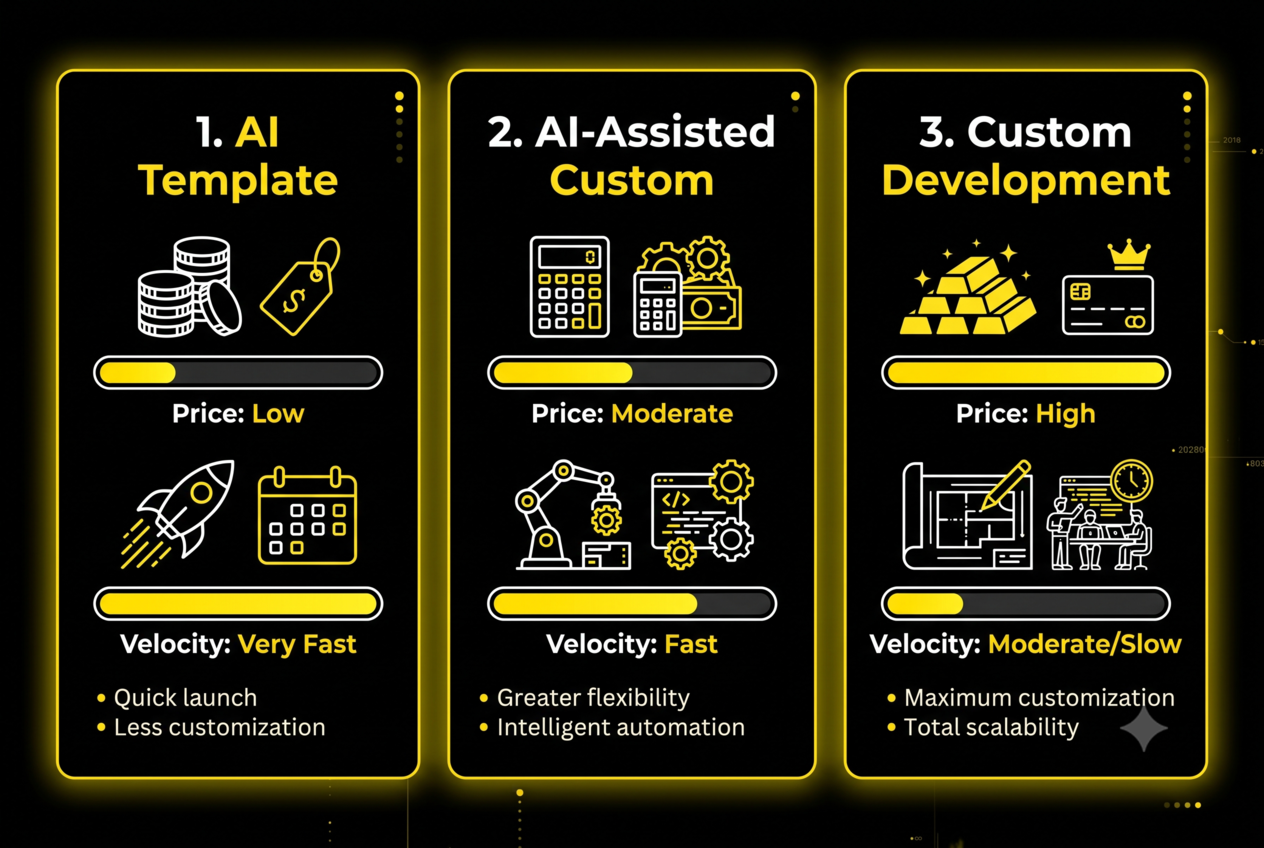
With AI in the picture, there are in practice three routes, not two:
- Template adapted with AI help. Copy generation, photo retouching and even support chatbots built in from the start. It is very fast and cheap, ideal for testing whether you can sell at all. The ceiling is the same as ever: once the catalogue grows or you need a specific integration, the template — with or without AI — hits its limit.
- AI-assisted custom development. Here AI speeds up parts of the agency's work (first drafts of components, testing, documentation), but the architecture, integrations and business decisions are still made by a team that understands your case. It is the option that best balances timeline and price for a business that already sells and wants a solid foundation without paying for the fully manual development of a few years ago.
- Fully custom development. Still exists for very specific projects, but it is increasingly rare for it to be manual from start to finish: the sensible approach today is for even the most custom build to lean on AI for the mechanical part and reserve human time for what genuinely sets the project apart.
Are prices still as high as ever?
They have changed, but not evenly. At the entry level, yes, prices have come down: building a simple shop today is faster and therefore cheaper than a few years ago. At the professional and custom level, prices hold in similar ranges, because what makes a serious project expensive — integrations, a well-structured catalogue, business judgement, maintenance — is not something AI solves on its own. What has changed is what you are paying for: less and less for writing code, and more and more for judgement, correct configuration and ongoing support. Our recommendation still follows the same business-stage logic: if you are just starting out, a template with AI help gets you live fast and cheap; if you already have revenue and your own rules, AI-assisted custom development gives you the robustness you need without overpaying for purely mechanical work.
What really drives the price
When we prepare a quote, the figure comes from five variables. Here they are, so you can estimate before you even talk to anyone.
The catalogue
Twenty products is not two thousand. And it is not just loading them: it is variants (sizes, colours, formats), product pages, photography and how it is all organised so people find things. A large, badly structured catalogue sinks sales no matter how beautiful the storefront is.
The design
An adapted template is cheaper and faster; a bespoke design sets you apart and usually converts better because it is built for your customer. Neither is wrong in itself. The mistake is paying for bespoke before you know the product sells — or settling for generic when you are competing in a crowded market.
Integrations
This is where much of a serious budget goes. Connecting the shop to your invoicing software, warehouse system, courier or the systems you already run saves hours every single day, but each connection has to be built and tested.
Content
Copy, photography and product descriptions. The most underestimated item, and the one that most affects whether Google finds you. A flawless shop with manufacturer-copied descriptions is invisible.
Who builds it
A freelancer, an in-house team and an agency do not cost the same — and do not offer the same support, timelines or continuity. The cheapest quote gets expensive when nobody answers the phone six months later.
The costs that appear later
This is what separates an honest quote from an unpleasant surprise. An online store is not a one-off payment: it is a business with running costs.
- Transaction fees. Payment gateways take a percentage of every order plus a fixed amount per transaction. It looks small until you multiply it by your annual volume — by far the most ignored recurring cost.
- Hosting and domain. Modest, but constant. And cheap hosting shows: a slow shop sells less.
- Licences and extensions. Many features people assume are included (advanced shipping, invoicing, subscriptions) are paid annual add-ons.
- Maintenance and updates. A neglected shop accumulates security holes. And a shop that is down is not an inconvenience — it is lost revenue.
- Getting customers. Nobody arrives on their own. Budget for digital marketing from day one, not after everything has gone into the build.
Our practical advice: set aside an annual running budget from the start. Spend it all on development and you will own a beautiful shop that nobody visits and nobody maintains.
What happens when price is the only criterion
We see this pattern constantly, and it usually ends the same way. The cheapest option wins, the shop launches, and within months the symptoms appear: you cannot change a price without help, the catalogue will not take a new variant, the images are so heavy the site crawls, there is no analytics telling you what is failing — and whoever built it has moved on.
Then comes the real invoice: rebuilding it. And rebuilding always costs more than building, because you have to migrate data, preserve your URLs so you do not lose rankings, and win back people who already tried to buy from you and could not.
Saving money is fine. Saving on the foundations is not.
How to work out what you need to spend
Instead of asking «how much does it cost», answer these four questions. With them, any serious professional can give you a realistic figure:
- How much do you sell, or expect to sell, per month? The budget should be proportional to the business, not to the excitement.
- Which tasks do you want the shop to take off your hands? Every automation costs money and pays for itself in hours.
- Who will run it day to day? If that is you, prioritise ease of use even if it costs a little more.
- What happens the day after launch? With no plan for traffic or maintenance, the project is unfinished.
How we approach it at Cruslar
We always start from the business, not the platform. First we understand what you sell, to whom and how you work internally; then we propose the simplest solution that solves it, and we show you the running costs alongside the build cost, so there are no surprises next year.
If a well-built template fits your project, we will say so. If you genuinely need a custom online store, we will say that too — and explain why, with numbers on the table.
Frequently asked questions
Is it cheaper to build it myself with a website builder?
Up front, yes. Medium term, it depends: those platforms charge subscriptions and, in some cases, commission on every sale. If you sell a little, it pays off. If you sell well, that commission ends up costing more than owning your own build.
How long does it take?
A simple shop can be live in weeks; one with integrations, months. The timeline is rarely set by the coding — it is set by having the content and photography ready.
Can I start small and grow later?
Yes, and it is usually the sensible route. The key is choosing foundations you can grow into without rebuilding: catalogue structure, well-planned URLs and exportable data.
What is a sensible minimum budget?
One that covers the build, the content and the first months of running and promoting it. A project that exhausts its budget on launch day starts with a limp.
Tell us about your project
If you are weighing up building your shop or rebuilding the one you have, tell us what you sell and how you work. We will tell you straight what you need, what you do not, and what each route costs. No obligation, no fluff.