Your business WhatsApp pings while your hands are busy with a client, and by the time you can check your phone, whoever was asking about a slot has already booked somewhere else. It's one of the quietest ways businesses lose appointments from slow WhatsApp replies, and it happens every day in salons, beauty studios and clinics that run on bookings. This article looks at why it happens, what the data says about response time, and how to fix it without needing someone glued to a phone all shift.
Why do slow replies cost you appointments?
When someone messages you on WhatsApp asking about a slot, they're rarely asking only you: they're comparing. While they wait for your reply, they keep looking at other options, and if it takes too long, they book wherever answered first.
They don't need to be upset or stop following you online. Most won't even tell you: they simply book with whoever replied first, and your message just sits there, read or unread, with no sign you've just lost a client.
Why it plays out differently in a beauty or wellness business
In an online store, someone can leave a chat tab open and reply the moment they get a free second. In an appointment-based business the problem is physical: while your hands are on a client, that phone can't be checked without neglecting the service you're already being paid for.
The result is a window of hours — an entire shift of treatments — during which any WhatsApp that comes in just waits. And it arrives exactly during the hours when most people ask about a booking: during the day, from work, grabbing a spare moment to check their phone.
What the data says about response time
A study by MIT and InsideSales.com that analysed more than 15,000 contacts and 100,000 calls across six companies found that the odds of actually reaching someone who asked about a service drop by up to 100 times if it takes 30 minutes to respond instead of 5 (source: MIT/InsideSales.com Lead Response Management Study). It isn't a beauty-industry study, but the mechanism holds for any business: whoever is asking usually has several options open at once, and sticks with whoever answers first.
Podium, a business messaging software company, notes in its own research that 78% of customers buy or book with the first business that replies, regardless of whether it had the best price or the best service (source: Podium).
Key idea: it isn't that your service is worse than the place down the street. It's that while you're deciding when you'll next get to check your phone, your client has already decided who to book with.
What happens when you don't reply in time
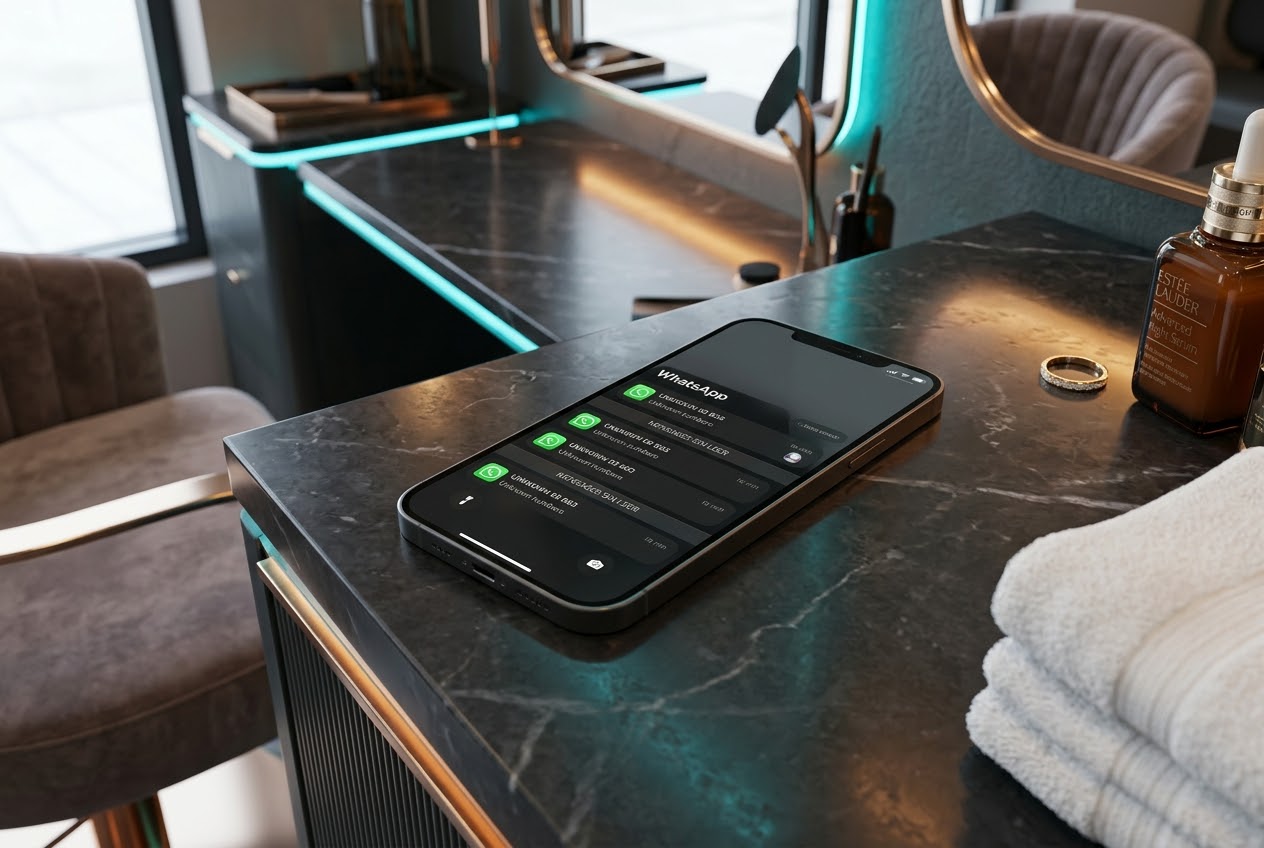
- The client books elsewhere, and you never even find out you lost her.
- WhatsApp fills up with unanswered messages, and it gets harder every day to find the ones that actually matter among photos, voice notes and repeated questions.
- Whoever does wait ends up asking the same thing more than once, and whoever replies keeps typing out the same information — price, hours, address — over and over.
- With nothing tracking it, there's no way to know how many appointments are slipping through like this, or what that's worth every month.
How to fix it without dropping service on the floor
The fix isn't having someone glued to a phone all day: for most businesses, that salary doesn't pencil out just to answer WhatsApp. What actually works is making sure a first reply goes out on its own, right away, even if nobody sees it yet.
That can range from an away message with your hours and a direct booking link, to an AI assistant that handles the usual questions — price, duration, availability — and books the appointment itself, without anyone having to put down what they're working on.
Setting up a first reply that doesn't let the booking slip
- Turn on an away message with your hours and a direct booking link, so anyone writing outside hours isn't left with nothing.
- Set up quick replies for what you get asked most: price, duration, whether a deposit is needed.
- Add a service catalogue to WhatsApp Business, so whoever's asking sees prices and options without waiting for someone to type them out.
- Add an AI assistant once the volume outgrows doing it by hand, so it replies and books straight into your calendar — always disclosing that it's an automated assistant.
- Review weekly what people ask and what the assistant can't answer yet, and fill in the gaps.
Which option fits your stage of business
If you run a single location with a handful of bookings a day, a well-written away message and a few quick replies in WhatsApp Business are usually enough: you don't need more than that to stop losing appointments during the hours you can't reply.
If you already have several staff members, more than one location, or WhatsApp never stops, that fixed message starts falling short: every client asks something different, and someone has to keep checking the phone constantly. That's where an AI assistant like Aura by Cruslar takes on work you can no longer cover by hand: it replies using your real information, books straight into your calendar, and never leaves a message unanswered, without any staff member having to put down their scissors to check the phone.
How to tell if it's working
You don't need complicated metrics. Track these three and you'll see whether the problem is improving or staying the same:
| Metric | What it measures | Rough target |
|---|---|---|
| First response time | How long it takes to answer the first message | Under 5 minutes during opening hours |
| Response rate | What share of messages get a reply | Close to 100% |
| Appointments confirmed via WhatsApp | How many conversations end with a booking on the calendar | Should rise month over month |
How we approach it at Cruslar
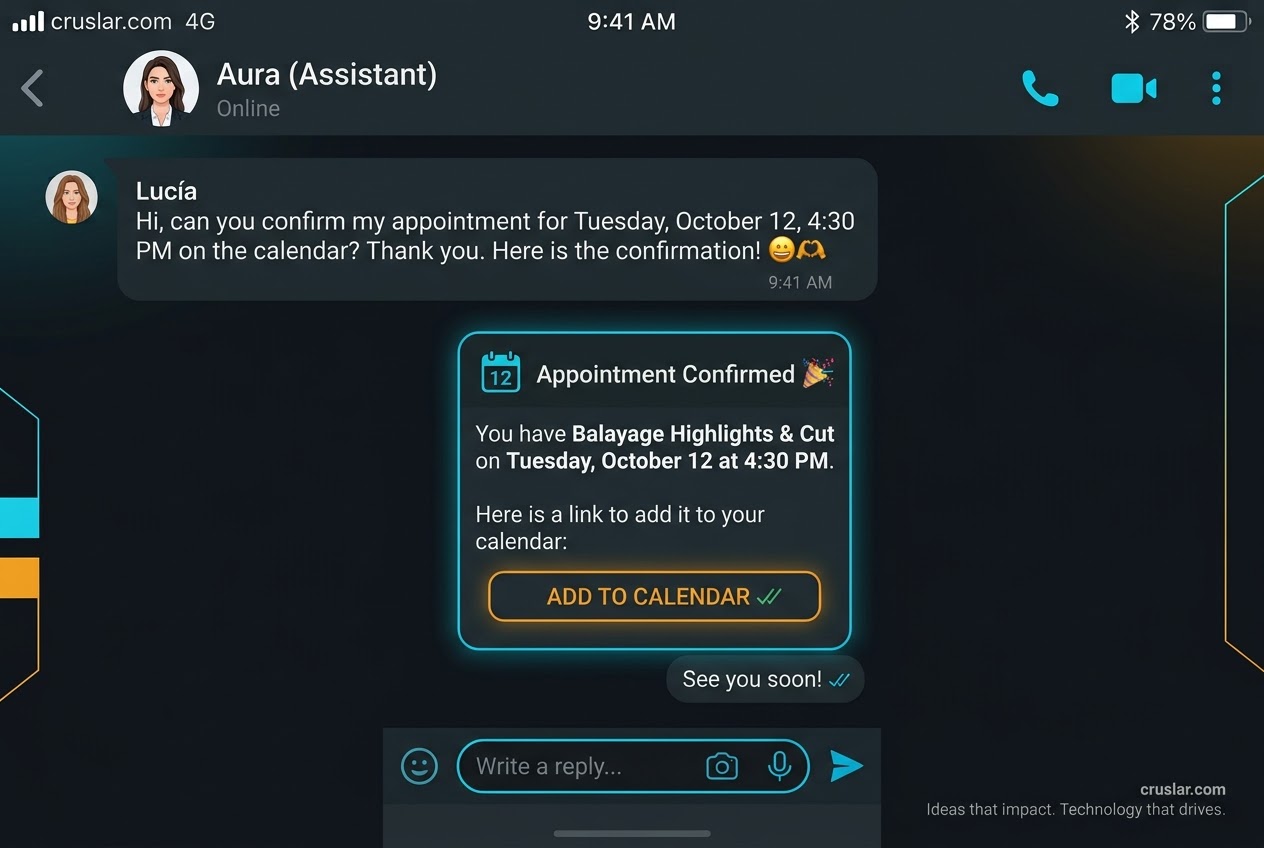
Before proposing anything, we ask what actually happens when a message comes in while hands are on a client. For a small business, the honest answer is usually a well-set-up away message: nothing more is needed, and telling you that is part of the job.
For businesses with several staff members and a WhatsApp that never stops, we built Aura by Cruslar, our AI-powered booking assistant: it replies on your behalf, handles the usual questions and books the appointment straight into your calendar, available on the web and installable as a PWA. Because it's an AI system talking directly with your clients, it always discloses that they're speaking with an automated assistant, as the EU's Artificial Intelligence Act has required since August 2026.
Frequently asked questions
How long do I have before I lose an appointment to a slow reply?
There's no single minute that applies to every business, but response-time data shows the odds of reaching that conversation drop sharply by the 30-minute mark. The sooner a first reply goes out — even an automated one — the more appointments get saved.
Is turning on WhatsApp Business's away message enough?
For a small business with a handful of bookings a day, usually yes. The problem shows up once message volume grows: a fixed message doesn't answer specific questions or book the appointment, it just says you'll be a while.
Can an AI assistant book the appointment on its own?
Yes, that's exactly what Aura by Cruslar does: it talks with the client, answers what she asks using your real information, and leaves the appointment logged straight into your calendar, with nobody having to enter it by hand.
Does it replace the person answering the phone?
It doesn't replace them, it takes over the repetitive part: hours, prices, availability and the booking itself. Anything that needs a human touch — a specific concern, a complaint, an unusual case — still reaches a person, just without anything getting lost in the meantime.
How much does it cost to set this up?
It depends where you start: an away message and quick replies in WhatsApp Business cost nothing beyond the time to set them up. An assistant like Aura carries a monthly fee, and it pays off once the appointments you're losing are worth more than that fee.
Let's talk about your business
If you don't know how many appointments are slipping through WhatsApp, that's the first number worth checking. Tell us how you handle messages today and we'll tell you honestly whether a well-set-up away message is enough, or whether your volume already calls for an assistant like Aura. You can also find more ways to stop losing time on repetitive tasks in our article on what to automate first in your business. Get in touch.
