Your business gets WhatsApp messages after hours, on weekends, while you're serving another customer in front of you. You know you need something that replies on its own, but you're not sure whether you need a simple WhatsApp chatbot or a full AI-powered assistant. They're not the same tool, they don't cost the same, and they're not built for the same job. This article looks at what each one actually does, what changed in Meta's 2026 rules, and how to choose without overspending or falling short.
What is a rule-based WhatsApp chatbot?
A rule-based chatbot runs on a closed decision tree: if the customer taps a button or types one of the words the bot recognizes, it replies with a message written in advance. Outside those predefined paths, it understands nothing — at best it repeats the menu or asks you to rephrase.
It works well for the predictable stuff: opening hours, address, order tracking, or confirming a booking that was already set. It's quick to set up with WhatsApp Business templates, and it costs little because there's no model to train or maintain.
What is an AI-powered WhatsApp assistant?
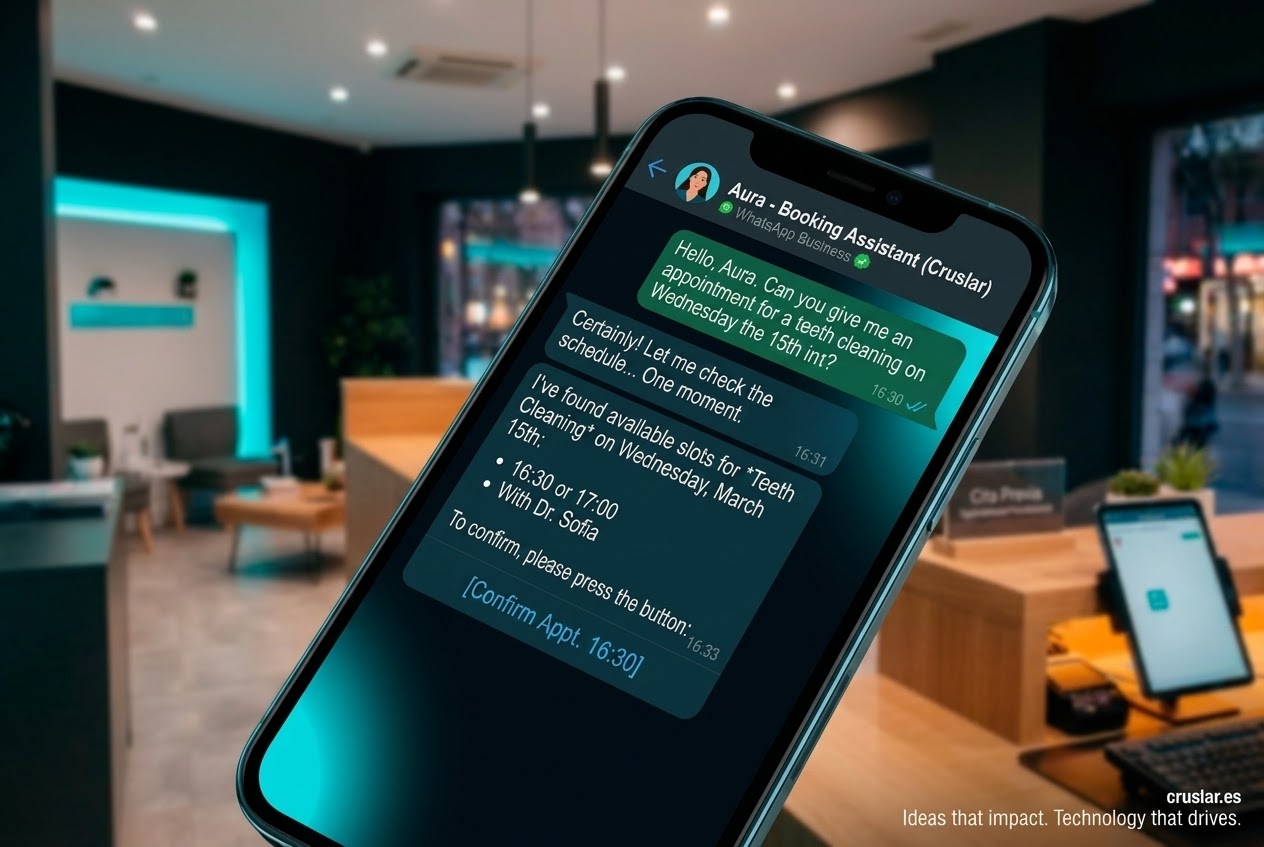
An AI assistant reads what the customer writes in plain language, not buttons or exact keywords. It understands intent even when the message is messy, remembers what was said earlier in the same conversation, and can chain several steps together: check the real calendar, suggest an open slot, confirm the booking and log it in the system — all within the same exchange.
The difference isn't just that it "sounds smarter." It's that it can resolve something start to finish without anyone on the team stepping in, even when the customer doesn't follow the script someone designed the bot around.
Why getting this right matters
The costliest mistake isn't building the wrong chatbot — it's promising more than the tool can deliver. A rule-based chatbot sold as "smart support" frustrates a customer the moment their message doesn't fit the tree, and that bad first impression costs the booking or the sale. The opposite mistake is just as real: paying for an AI assistant to answer nothing but opening hours is overspending on something a three-button menu already handled just as well.
Key idea: the question isn't which one is better in the abstract — it's how varied the WhatsApp conversation your business actually gets on a normal day.
Rule-based chatbot or AI assistant: the comparison
| Aspect | Rule-based chatbot | AI assistant |
|---|---|---|
| How it understands | Buttons and exact keywords | Natural language |
| Memory | Doesn't recall earlier messages | Follows the whole thread |
| Tasks | One simple action at a time | Several chained steps |
| Setup | Fast and cheap | Needs the business configured |
The Meta rule that changes the board
Since January 15, 2026, Meta has banned general-purpose AI chatbots on the WhatsApp Business Platform (API): any bot built on a language model that answers questions on any topic, essentially dropping a loose ChatGPT-style chat into your business WhatsApp. What remains allowed — and what Meta actively permits and encourages — are bots structured around one specific business task: customer support, order tracking, bookings and appointment management, notifications.
In practice, this means any AI assistant has to be built around a closed business process — book, confirm, cancel, check availability — rather than as an open, general-purpose chat that answers anything. That's exactly the line between "a loose language model sitting inside your WhatsApp" and "an assistant that only knows how to manage your calendar." If you're evaluating a vendor, that's the first question worth asking: is the bot scoped to your process, or is it, underneath, a generic chat wearing your logo.
What happens when you pick the wrong one
- The rule-based chatbot falls short the moment a customer writes something outside the script, and that's exactly where the booking or the sale gets lost.
- A poorly configured AI assistant can promise availability that doesn't really exist, or confirm something someone on the team then has to undo by hand.
- Neither one fixes a poorly defined process: if the business itself isn't clear on how it manages its own calendar, automating it just spreads the same chaos faster, to more customers at once.
How we approach it at Cruslar

Before proposing an AI assistant, we look at how varied the business's real conversation actually is: if almost every message is one of the same five repeated questions, a well-built rule-based chatbot can be enough, and it's cheaper. When the real conversation includes rescheduling, checking availability on another day, switching services, or off-script questions, that's where we build Aura by Cruslar, our AI-powered WhatsApp assistant designed for appointment-based businesses: it understands the message in natural language, checks the business's real calendar, and confirms without anyone on the team stepping in — staying within the structured-task boundary Meta has required since January 2026, because it doesn't answer questions on any topic: it manages bookings, and nothing else.
Which option fits your business's stage
If you're just starting out or still validating the business, a rule-based chatbot with two or three buttons — hours, location, book now — handles most messages without overspending. You don't need the most advanced option on the market; you need to stop losing messages while you're busy with the customer in front of you.
If you're already generating steady revenue and the calendar shifts all day — last-minute cancellations, rescheduling, multiple locations or several staff at once — an AI assistant like Aura starts paying for itself: every conversation it closes on its own is one that doesn't interrupt the team or depend on someone being free right at that moment.
How to tell if it's working
| Metric | What it measures | What to look for |
|---|---|---|
| Resolved without a person | Conversations closed with no team member involved | Rising month over month |
| Escalated to a human | Cases the assistant can't close on its own | Falling over time |
| Response time | How long the first reply takes | Seconds, not hours |
According to global data from Zendesk's AI customer service report, a conversation resolved by an AI assistant costs an average of $0.62 versus $7.40 for one handled entirely by a person, and customer satisfaction (CSAT) sits just 0.2 points apart between the two when the assistant escalates hard cases to a person instead of forcing an answer it doesn't have. These are global industry benchmarks, not a forecast for your business, but they show what to expect from a well-configured assistant: it doesn't remove people from the process, but it cuts down sharply how often they're needed.
Frequently asked questions
Are regular WhatsApp chatbots banned now?
No, they're still allowed, as long as they're scoped to one specific business task (bookings, orders, support). What Meta banned starting January 2026 is a general-purpose bot that answers questions on any topic, not ordinary structured chatbots.
Can I start with a rule-based chatbot and move to an AI assistant later?
Yes, and that's actually the most common path: many businesses start with a button menu and make the jump once the real conversation gets too varied for a fixed decision tree.
Does an AI assistant force me to change my booking system?
It shouldn't. A well-built assistant connects to the calendar or system you already use — it doesn't replace your tools, it talks to them and logs what it confirms right there.
How do I know how varied my WhatsApp conversation really is?
Look back at a couple of weeks of real messages: if the same five questions keep coming up, a rule-based chatbot is more than enough. If every conversation asks for something different, that's where an AI assistant actually makes a difference.
Does Aura comply with Meta's January 2026 policy?
Yes: Aura is built around one specific business task — appointment management — exactly the kind of structured bot Meta permits and encourages on its platform, not an open, general-purpose chat.
Let's talk about your WhatsApp
If you're not sure whether a simple chatbot is enough or you already need an AI assistant, tell us what your real messages actually look like and we'll tell you honestly which one fits. If your business runs on appointments, it's worth checking how many bookings you might be losing to slow WhatsApp replies and how to automate your calendar without switching software. Meet Aura by Cruslar or get in touch.
