If you're wondering how WhatsApp restaurant reservations actually work, the short answer is they're not just a manual chat where someone jots down tables by hand: done right, WhatsApp itself confirms the table, sends the reminder and manages the waiting list, without anyone having to step off the floor to answer the phone mid-service. This article covers what changes compared to phone bookings, what gets automated first, and which option fits the size of your restaurant.
What do WhatsApp reservations for a restaurant actually mean?
It's not all the same thing. At the most basic level, a guest messages the restaurant's WhatsApp and someone on staff replies by hand — the same as taking a phone call, just typed instead of spoken. It works, but it still depends on someone being free to answer.
A step further is an assistant that confirms the table, logs it in the booking system and sends the reminder on its own, without staff typing a single word. The guest is still talking to the restaurant's WhatsApp the whole time — what changes is who's answering on the other end.
Why the phone falls short during the rush
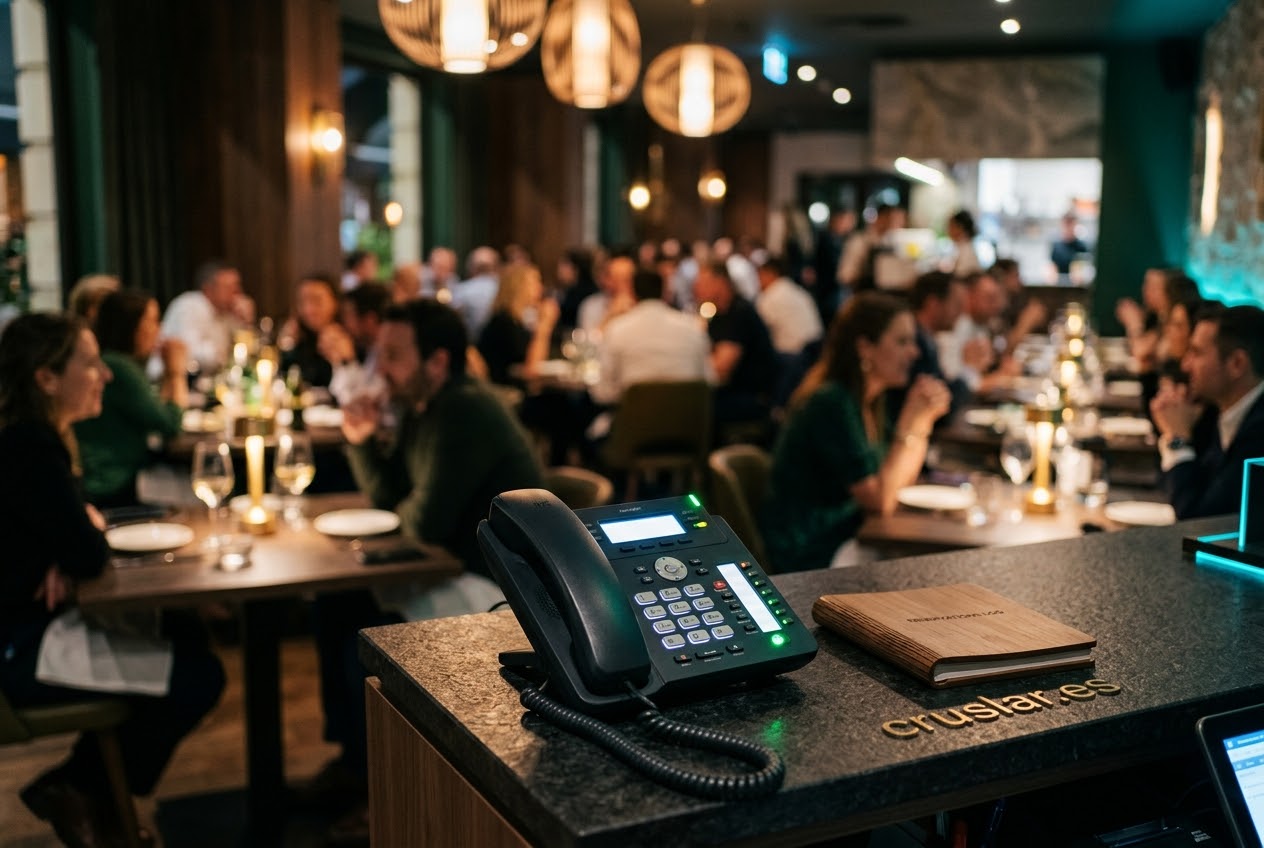
The phone works fine while the restaurant is quiet. The problem shows up at 1pm or 9pm, when the dining room is full, the kitchen is at full speed, and whoever normally answers calls is running food. That's when the phone rings and nobody picks up, or someone grabs it mid-shift and scribbles the booking on a slip of paper that still has to be entered into the system later.
And this isn't just about comfort anymore. According to EZ Texting's 2026 Consumer Texting Behavior Report, when people have a question for a business they'd rather text (33%) than call (18%); and Toast's own data shows younger diners are the least likely to book by phone, preferring a digital channel instead. A restaurant that only takes bookings by call is asking guests to make an effort fewer and fewer of them are willing to make.
Key idea: the problem is rarely a shortage of guests. It's that the channel they're trying to book through isn't free exactly when they need it.
What happens when a booking depends on someone answering in time
- The booking disappears without anyone noticing: a guest who can't get through tries somewhere else, and the restaurant never even learns that demand existed.
- No-show risk goes up: without automatic confirmation or a reminder, a booking scribbled by hand is easier to forget — for the guest and for the restaurant itself.
- Mistakes multiply during service: a table given out twice or a booking logged at the wrong time costs more during the rush than at any other moment.
- Nobody measures anything: without a system recording every booking, the restaurant has no way to know how often this happens or whether it's getting better or worse.
Every table left empty because of a mishandled booking is a direct cost, not just a hiccup: that slot doesn't come back during the same service, and nobody even knows it happened without a system tracking it.
There's real data on no-shows: the Resos No-Show Index 2026, covering 3.77 million reservations across 2,417 restaurants between August 2025 and July 2026, puts the average at 2.33%, with sizeable differences by country — from 0.49% in Switzerland to 5.88% in France. The gap tends to track whether a restaurant sends automatic confirmations and reminders or relies on someone remembering to do it by hand.
Phone bookings versus automated WhatsApp bookings
The difference shows up most in two moments: when the restaurant is at its busiest, and once the kitchen has closed but a guest still wants to book for another day.
| Aspect | By phone | Automated WhatsApp |
|---|---|---|
| Availability | Only if someone answers | 24 hours, every day |
| Booking record | By hand, can get lost | Logged automatically |
| Reminder beforehand | Rare, if there's time | Sent on its own |
| Confirmation to guest | On the same call | Instant, in writing |
How a well-built WhatsApp booking flow works
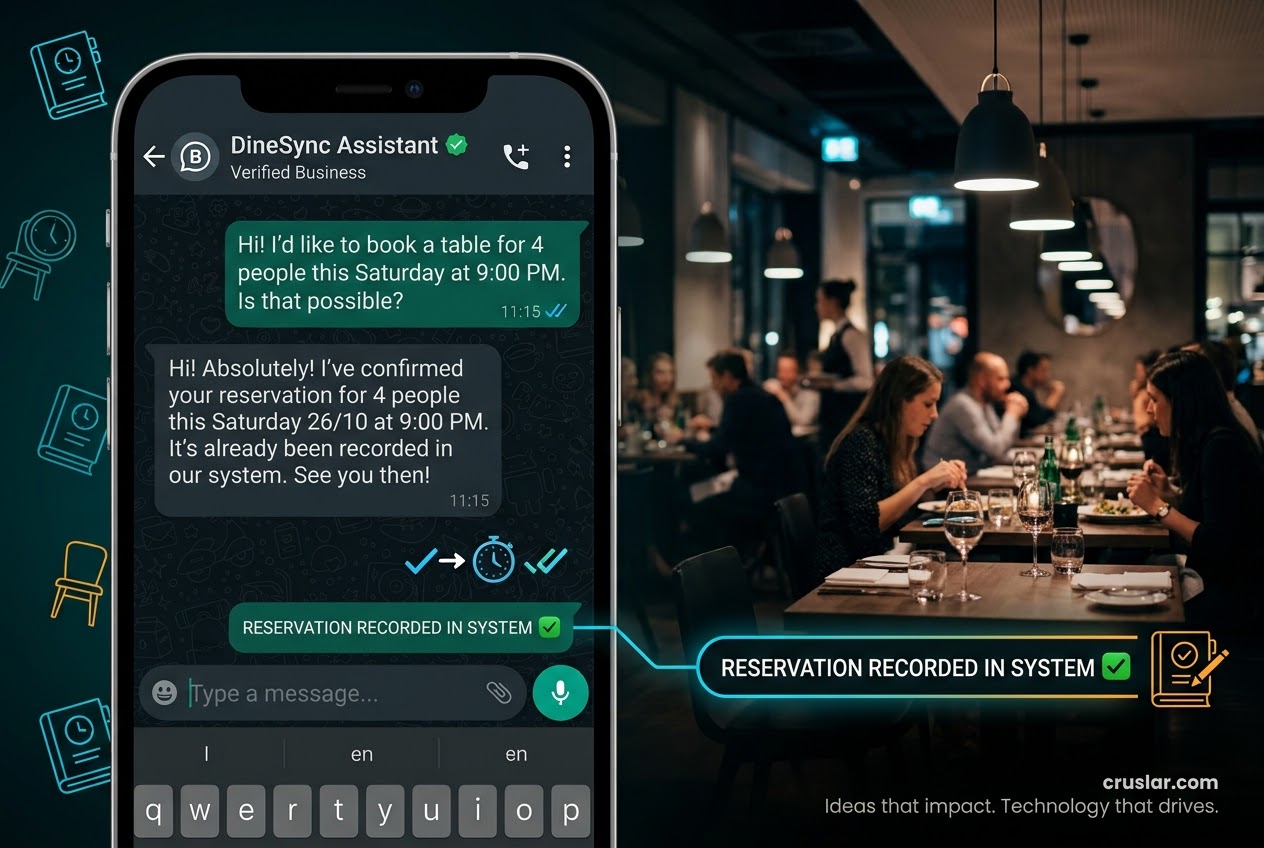
You don't need to build it all at once. This order tends to work best:
- The guest messages the restaurant's WhatsApp, the same way they'd message any other contact.
- The assistant asks the essentials — date, time and party size — and checks real availability in the booking system.
- It confirms the table on the spot and logs it in the same place staff already use to run the floor.
- It sends a reminder before service, with the option to cancel or change the time without calling.
- It notifies the waiting list the moment a table frees up, instead of leaving it empty.
What a good WhatsApp booking assistant should include
Not every option offers the same thing. Before choosing one, make sure it covers at least this:
- Checks real availability, not a separate calendar someone has to update by hand.
- Confirms in writing, so the guest keeps the booking saved in their own WhatsApp instead of relying on remembering a call.
- Handles changes and cancellations without the guest having to call or message a different person.
- Respects the seating capacity and service times the restaurant has already set, instead of accepting bookings that don't actually fit.
- Understands the guest's language, especially useful in areas with a lot of tourism.
The myth of "I'd have to replace my booking system for this"
This is the objection we hear most, and it makes sense: switching POS or booking software mid-season, with guest history and table setups already configured, sounds exhausting just to think about.
You don't have to. A WhatsApp booking assistant can sit on top of the system you already use to run the floor, instead of replacing it: your system still runs the show, and the assistant only handles the conversation and logs the table where staff already check it every shift.
Which option fits your restaurant's stage
If you've just opened or run a single location with a handful of bookings a day, a well-set-up WhatsApp Business account and someone checking messages during quiet moments is usually enough. You don't need more than that to stop losing bookings because nobody picked up the phone.
If you already run several services a day, more than one location, or a WhatsApp that doesn't stop through lunch, that's where an assistant like DineSync takes over work there's no longer time to handle by hand: it confirms, reminds and manages the waiting list on its own, without anyone stepping off the floor to answer a message.
How to tell if it's working
| Metric | What it measures | Rough target |
|---|---|---|
| No-show rate | Confirmed bookings that don't show | Under 5% |
| After-hours bookings | The ones that arrive when the phone isn't answered | All confirmed the same way |
| Slots recovered | Cancellations that get rebooked | Most of them, via the waiting list |
How we approach it at Cruslar
Before proposing anything, we look at where your restaurant's bookings actually come in today and at what points they're most likely to get lost. For a small location, tidying up the WhatsApp Business you already have — clear hours, a welcome message, someone checking it during downtime — is often enough.
For restaurants running several services or several locations, we built DineSync, our management system with a built-in WhatsApp booking assistant: it talks with your guests, checks real availability and confirms the table directly in the system, without replacing the POS or software you already use to run the floor. Because it's an AI assistant talking directly with guests, it always discloses that it's an automated system, as the EU's Artificial Intelligence Act has required since August 2026 — worth doing even where your market falls outside the EU.
Frequently asked questions
Do I need to switch booking systems to use WhatsApp?
No. A WhatsApp booking assistant sits on top of the system you already use, without replacing it: the table still gets logged where staff already check it.
Does it work for a single-location restaurant?
Yes, though for a small volume of bookings a well-set-up WhatsApp Business account may be enough on its own. An automated assistant starts paying off once volume outgrows what one person can handle.
Do guests know they're talking to an assistant?
Yes, and that's by design: it discloses from the first message that it's an automated system, not a person.
Does it actually cut no-shows?
Instant confirmation and an automatic reminder are the two measures that do the most to keep a booking from being forgotten, by the guest and by the restaurant alike.
What happens to bookings that come in after hours?
They're handled the same as any other: the assistant doesn't close when the phone line does, so a booking made at midnight gets confirmed just like one made at noon.
Let's talk about your bookings
If you don't know how many bookings you're losing today to a phone nobody could answer, that's the first thing worth looking at. Tell us how you handle bookings now and we'll tell you honestly whether tidying up your WhatsApp Business is enough, or whether your volume already calls for a system like DineSync. If you also use WhatsApp for reminders and confirmations, it's worth knowing what changes in WhatsApp Business pricing from October 2026 and what the law requires you to disclose when an AI is the one replying. Get in touch.
